

Happy Valentine's Day!
I hope everyone, free or ball-and-chained, has a wonderful little holiday!
Been busy working on learning how to develop color film. Here is a shot I did today using Kodak Ektar 100 film which I developed personally. I love the results! Film definitely has its own feel . . . . feels more real than digital.


Experimenting with Ideas
Still Lifes are rated extremely low on the totem pole in the Art and the Photographic world. The art world has always regarded still life paintings as sub-par, and, I believe, they still do today. Even the Dutch Masters in the 17th century regarded the Vanitas-movement as not really worthy of higher recognition. The same with photography.
I think it’s because people want to look and feel; it’s all about instant responses. You know the Afghan Girl? Yeah, powerful image and the photographer didn’t even know he had something until his editor processed and published it. Still Lifes are difficult to do because they don’t always have that instant gratification. It can take time to understand what is going on in the image to grasp the full-meaning.
Still lifes are my most favorite form of painting and photography. They represent a marvelous way of conveying philosophy and metaphysical values. I don’t want to come across as high-minded in the age where photography is more about instant reactions and emotion, but I love still lifes because they can make you think in a variety of ways that will often surprise yourself, even if they can be really boring to look at.
So, I’m presenting you with a still life.
Normally, the artist/photographer doesn’t reveal the meaning behind such symbolism . . . as if they don’t want to reveal how the bunny got into the hat. Maybe because they were tired of trying to sort out the whole thing and decided it was best to lay it out for the audience and let them sort the mess out? Laziness. It shouldn’t be: I’m leaving the meaning up to you, I’m sure you’ll figure it out. No artist should want that. Personally, I believe the audience has a right to know what the artist/photographer is thinking. Putting it all in their lap to decide the meaning is just foolish and lazy. Kinda like that banana duct-taped-to-a-wall crap?
If you prefer not knowing my thought behind this photo, just view the image below and not read beyond!
Skulls have a variety of meaning—death, predominantly. I’m using it as a transition-of-sorts in this case. Throughout history, death is viewed in many different ways. Often as a hopeful sign of transition from one life to the next. I chose to use the lopsided skull as a sign of transition , but not anything necessarily grounded as death. There’s still room to learn even in the face of such an absolution.
Daisies typically represent purity and innocence in past cultures. However, these blossoms are withered. Freya is the nordic goddess of Love and her flower is the daisy. For the Nords, the daisy stands for beauty and innocence and youth. I chose to let these blossoms wither, but not completely die, in the eye sockets, as a sign of transitional life through knowledge. Wisdom requires the absence of all innocence, afterall.
The book represents knowledge. Kind of clichéd, I know, but I made sure the book’s binding remained skewed as a sign of another way of thinking. And, note, the pages proceed forward to the end . . .
The light is focused on the skull. I intended this to stand as the primary focus and as a sign that the brain is the driving force behind all human thought. Should I have wanted a more divine sign the whole image would have been lit up equally, but I allowed the majority of the image to remain dark as a sign of the knowledge we have yet to learn. We have room to grow through wisdom and experience.
I’m curious what you think! Please comment below!
Red Blossom Lines
Found some mysterious red blossoms the other day. Not sure what they are, but I loved the delicate texture of the blossoms and the twisty way the stems grew.
Omega View 45; Schneider 210mm; Ilford HP5; Caffenol C-L
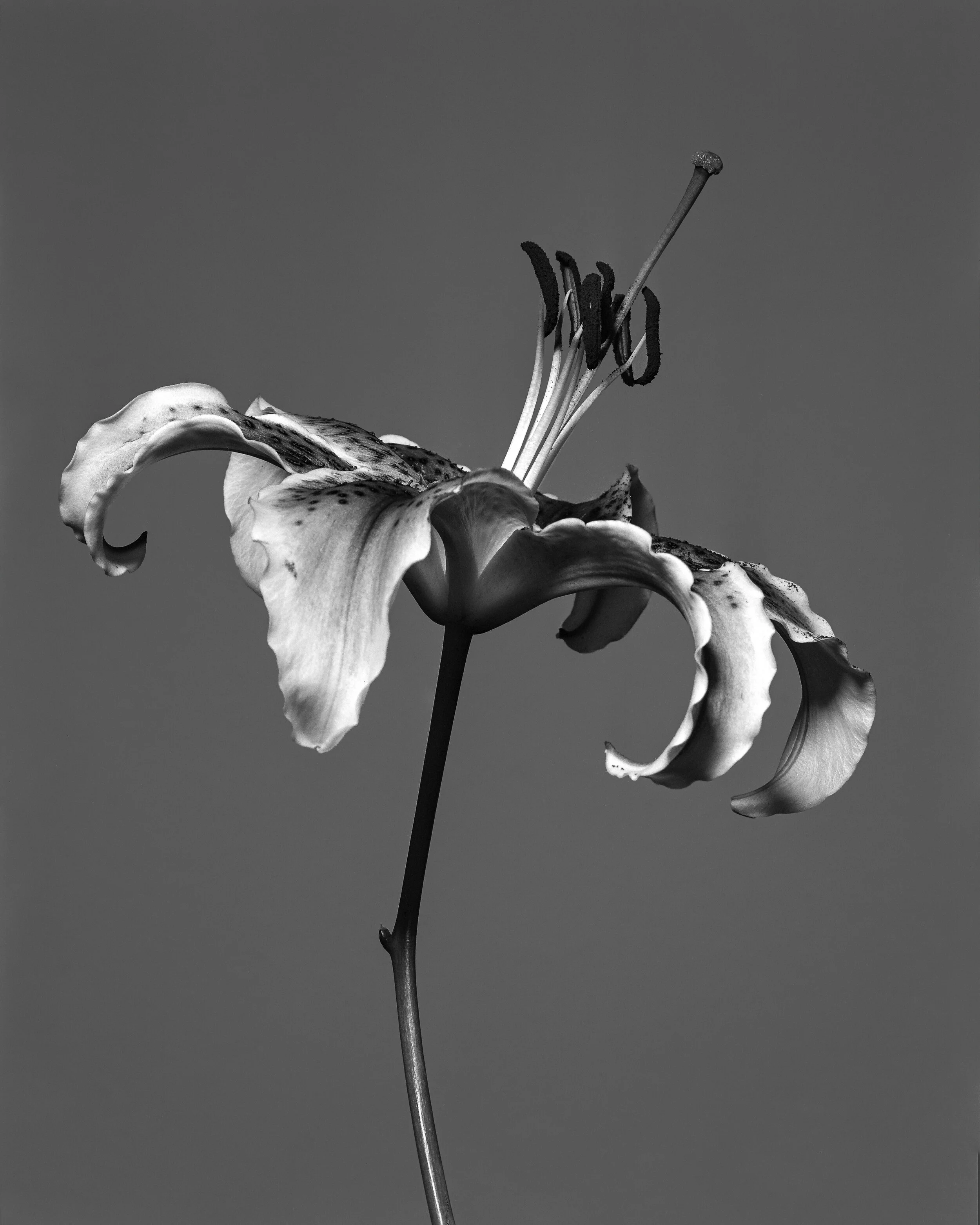
Feeling Blue: Pink Striped Lilies
I found some Pink Striped Lilies at the market the other day. Such gorgeous colors I had to bring them home with me! Despite their vibrant colors, I wanted to shoot them on Ilford’s black and white HP5 film.
Using a touch of color, namely a blue filter on my lens, caused the deep red and pink of the petals and the green of the leaves to darken nicely and create dramatic tones and textures. You can see why blue filters are seldom used for black and white portraits.


Caffenol: Developing Film with Coffee, an Intro
Ask any analog photographer who has developed their own film and they will talk your ear off. They will wax eloquent about the process and the romance of the whole doing-it-yourself-in-the-darkroom. It’s intoxicating, I admit, and not in a chemically-induced way. There’s a mystique around developing your own film rather than waiting for the film to return from the lab. You get more of an “ohhhh” effect when you first take out freshly developed film that you did yourself; you don’t get that feeling when you finally get your film back from CVS.
There are quite a few ways to develop film, but they all rely on the same basic process: an acid is applied to the exposed film, another acid is used to stop development, and a fixer is applied to “fix” or prevent the film from reacting further to light. Really simple process overall.
Typically, developer is made up of hydroquinone, phenidone, or dimezone. All of which are acidic. Acid is needed to bring out the silver halides in the film. Sometimes other chemicals are used to increase the acidity like sodium hydroxide or sodium carbonate. A stop bath is added to prevent over-exposing the film by halting the developer and washing it completely away. An acetic acid is used in this step, however, water and very thorough rinsing to wash away remaining developer may also be used (there’s a lot of debate over this aspect, but if you do it thoroughly and quickly, like I do, you never notice a difference). Lastly, the fixer. This step is typically made up of using either ammonium thiosulfate or sodium thiosulfate. The fixer washes away any unexposed silver in the film and preventing any further reaction to light. The image is now “fixed” on the film. Clever name, eh?
So, with names like acetic acid and hydroquinone, one has to wonder . . . are these chemicals really necessary? They can be, but that’s not what Caffenol is all about. Back in 1995, a clever bloke who goes by the name of Dr. Scott Williams, PHd of Rochester Institute of Technology (RIT) discovered an alternative way to develop black and white film using household items that aren’t toxic and can be bought at your local market or pharmacy. And, it’s so easy that a caveman can do it!
The Ingredients
Caffeic acid: This can be found in any number of things like coffee, tea, wine, or spirits. Instant coffee is more commonly used. It’s not the caffeine we’re after, but the caffeic acid. So, buy the cheapest instant coffee you can find, especially if it’s labeled “strong”. Right now I have a big ol’ tub of Folger’s in my chemical arsenal. Make sure you buy crap-coffee, because it’s useless afterwards when you use it to develop film so there’s no sense in buying Starbucks for this.
Vitamin-C: In powdered form! You can find this easily in health food stores and those vitamin shoppes that only huge bodybuilders (and wannabes) frequent for their protein shakes. “C” works as a second developer and helps give the film more contrast. A lot of recipes omit C, but I think it’s essential. Plus, C plays well with caffeic acid, so it assists in speeding up developing time (which is already long enough with caffenol than regular developer).
Washing Soda: Soda is used as a pH modifier which helps make the caffenol solution more alkaline. It’s big job is to activate the developing agents thus making the whole song-and-dance happen. Most problems with caffenol originate with the washing soda, which must be “water-free” or “anhydrous”. Baking soda will not work! If your soda has water in it, it must be cooked out. In other words, pain-in-the-butt. So, just buy proper washing soda and save yourself from putting yourself in the poor house via the Swear Jar when your film comes out under-developed, or not at all.
Potassium Bromide: Ok, this one isn’t exactly a household item, however its replacements are. Bromide is used as a restrainer and anti-fogging agent. It basically keeps the developer in check and not going hog-wild. Fast films (+400iso) and anyone who develops using the “standing” method (more on that later with Caffenol C-L) should absolutely use it. Iodized salt works as a replacement to bromide, just use 10x the stated amount of bromide. Regular non-iodized table salt may be used in a pinch [cue, rimshot], just use 20x the stated amount of bromide. Ideally, use bromide. If you don’t have some and you’re just starting out and your film is ‘slow’, go with the salt.
Dihydrogen Monoxide: Water, Helen. Water. If you have funky water—or if you live in Flint, Michigan—it might be a good idea to use demineralized water. Personally, I’ve never had an issue with tap water. After all, this whole process is about simplification, so keep it simple! The only boggle with water is you want to maintain a pretty consistent temperature. So, use a thermometer, or, better yet, a Sous-vide machine, if you have one. I use one and it simplifies the whole process! Keeping the developing tank in a tub fitted with a sous-vide machine keeps the temperature very consistent, which comes in handy for standing development.
Process
Ok, now comes the fun part! Choose your recipe and gather your ingredients! (All ingredients below are measured per liter. Also, I’m going to assume you know something about developing film.)
Caffenol C-M and Caffenol C-H, below, both require the same process, however their ingredients vary slightly and they are used for slightly different reasons.
Caffenol C-M
Used for medium speed films
Used if pulling/pushing film is needed
54 g Washing Soda
16g Vitamin-C
40g Instant Coffee
Caffenol C-H
Used for general purpose developing
54g Washing Soda
16g Vitamin-C
1g Potassium Bromide
40g Instant Coffee
Pour 1L of 20˚C water into a beaker or measuring glass. Mix in ingredients in order being sure each addition is completely dissolved before adding the next one. Let rest 5 mins for coffee to fully dissolve.
Pour into film canister and agitate for 10 seconds each minute for 15 minutes.
Pour out Caffenol and rinse thoroughly with water.
Add fixer for 6 mins, agitating every 50 seconds for 10 seconds.
Dry and hang, as normal
Caffenol C-L
Used for general purpose developing
Used when finer grain is needed for slow film
Note: This process involves Standing Development which means the solution is left alone during the majority of the development phase. There is very little agitation, so make sure each ingredient is thoroughly dissolved before adding the next one. Potassium bromide is important for this process! 1.5g is a suggestion. I usually do between 1g and 2g depending on how contrasty I want my film to be.
16g Washing Soda
10g Vitamin-C
1.5g Potassium Bromide
40g Instant Coffee
Pour 1L of 20˚C water into a beaker or measuring glass. Mix in ingredients in order being sure each addition is completely dissolved before adding the next one. Let rest 5 mins for coffee to fully dissolve.
Mix into film canister and agitate for first 30 seconds. Leave standing for 70 minutes.
Pour out Caffenol and rinse thoroughly with water.
Add fixer for 6 mins, agitating every 50 seconds for 10 seconds.
Dry and hang as normal.
Final Thoughts
Personally, Caffenol C-L is my go-to developer for Caffenol developing. I’ve had the most luck with it and it produces very low-grain and yummy contrast. C-L takes much longer than regular developer, which takes about 7 minutes. But, C-L yields the best results of any alternative developer I’ve had the pleasure to use so far.
A couple of things to keep in mind:
Caffenol developer can not be stored before or after use. Mix it, let it rest for 5 minutes, use it, and pour it down the drain. No, you can’t use it for coffee in the morning (yuck). This stuff smells like dog food when you mix it. (double yuck).
Keep the temperature as consistent as you can throughout development. Since I prefer the C-L, which stands for over an hour, this is why I use my sous-vide.
Do not use it on anything uber-important! Caffenol can fail easily if your washing soda is corrupted.
Caffenol will more than likely stain your film brown. This isn’t incredibly important overall, just don’t be shocked when you take it out of the solution.
Examples


